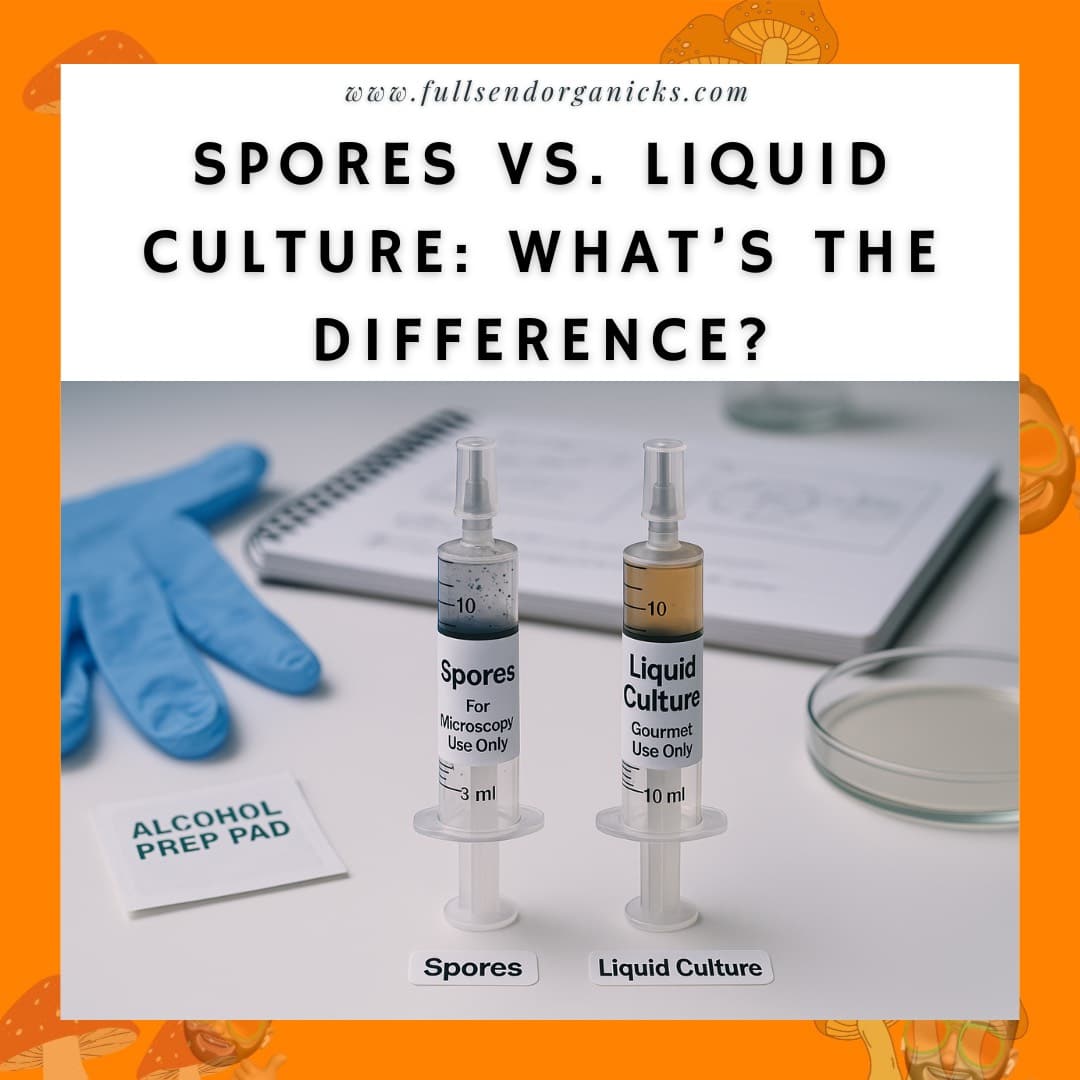
When you start researching mushroom cultivation, two terms come up immediately: liquid culture and spore syringe. Both are used to inoculate substrate and start a grow. However, a liquid culture vs spore syringe comparison reveals important differences in speed, shelf life, and what each one is best suited for.
Choosing the wrong one for your situation wastes time and money. This guide explains exactly what each one is, how liquid culture vs spore syringe compares side by side, and which makes more sense depending on your experience level and goals. After 20 years of cultivation experience, the answer is not always the one beginners expect.
What Is a Spore Syringe?
A spore syringe is a sterile solution containing mushroom spores suspended in distilled water. Spores are the reproductive cells of a mushroom — the equivalent of seeds in the plant world. They contain the genetic blueprint of the mushroom but have not yet begun to grow.
Because spores have not germinated, a spore syringe contains no living mycelium. The spores must germinate and colonize before any visible growth begins. This adds time to the process compared to liquid culture.
Spore syringes have several important advantages. They store exceptionally well — a properly refrigerated spore syringe remains viable for 6 to 12 months. They are also the primary tool used for taxonomy and microscopy work, because spores viewed under a microscope reveal the characteristic features used to identify and study different Psilocybe cubensis strains. According to Fungi Perfecti, spore syringes remain one of the most reliable methods for preserving fungal genetics long term.
At Fullsend Organicks, all spore syringes are available individually or as part of our 5 for $75 bulk spore syringe deal. You can also browse our complete Psilocybe cubensis spore library with over 350 strains.
What Is a Liquid Culture?
A liquid culture syringe contains live mycelium — the vegetative network of a mushroom — suspended in a sterile nutrient solution, typically light malt extract or sugar water. Unlike spores, the mycelium inside a liquid culture is already alive and actively growing.
Because you start with live mycelium rather than ungerminated spores, liquid culture colonizes grain or substrate significantly faster than a spore syringe. A liquid culture often shows visible growth within 3 to 7 days. A spore syringe typically takes 10 to 21 days to show initial colonization because spores must germinate first.
Liquid culture also colonizes more evenly and aggressively, which reduces the window during which contamination can take hold. The North American Mycological Association notes that contamination prevention is one of the most critical factors in successful mushroom cultivation — and faster colonization directly reduces that risk.
Browse our full selection of gourmet and medicinal liquid cultures, or choose any 5 strains with our 5 for $85 liquid culture bulk deal.
Liquid Culture vs Spore Syringe: Side-by-Side Comparison
Here is a direct liquid culture vs spore syringe comparison across the factors that matter most to cultivators and researchers.
Colonization speed: Liquid culture wins. Because the mycelium is already alive, colonization begins immediately after inoculation. Spore syringes require germination first, which adds days to weeks to the timeline.
Contamination resistance: Liquid culture wins. Faster colonization means a shorter window for contamination to compete. Spore syringes are slower to colonize, giving potential contaminants more time to establish.
Shelf life: Spore syringes win. A properly refrigerated spore syringe lasts 6 to 12 months. Liquid cultures are viable for 3 to 6 months refrigerated. For long-term genetics storage, spore syringes and spore prints are the more practical choice. Our guide on how to store spore syringes and liquid cultures covers best practices for both.
Genetic consistency: Liquid culture wins for known genetics. A verified liquid culture from a reliable source gives you exactly the genetics you ordered. Spores carry two sets of genetics that recombine on germination, so there is natural variation between individual germinations from the same syringe.
Microscopy and taxonomy use: Spore syringes win. Spores viewed under a microscope show the morphological features used to identify and study strains. Mycelium from liquid culture does not provide the same taxonomic data.
Availability of rare genetics: Liquid culture wins for mutations. Some strains — most notably Enigma — produce no spores at all and only exist in liquid culture form. If you want to work with sterile mutations, liquid culture is the only option. You can read more about why in our complete Enigma mushroom guide.
Price: Comparable. At Fullsend Organicks, the bulk deals — 5 spore syringes for $75 versus 5 liquid cultures for $85 — reflect the slightly higher production cost of maintaining live cultures.
Which One Should You Use?
The liquid culture vs spore syringe decision depends on what you are trying to accomplish. Here is how to think about it.
Choose a spore syringe if: your primary goal is microscopy, taxonomy research, or building a long-term genetics library. Spore syringes last longer, are easier to store, and give you the morphological data needed for identification work under a microscope.
Choose a liquid culture if: you want to grow gourmet or functional mushroom species — lion's mane, oyster, reishi — at home. Liquid culture colonizes faster, resists contamination more effectively, and gives consistent results from known genetics. Our gourmet and medicinal liquid cultures are maintained specifically for this purpose.
Choose liquid culture if you want Enigma or other spore-free strains. As explained above, some genetics simply cannot exist in spore form. For those, liquid culture is not a preference — it is the only option.
How to Store Both Correctly
Proper storage is what keeps your genetics viable between uses. The approach is similar for both liquid culture and spore syringe, with one key difference in shelf life.
For both liquid culture and spore syringes, follow these storage rules:
- Refrigerate immediately upon receipt at 35°F to 46°F (2°C to 8°C)
- Store away from the refrigerator door where temperature fluctuates with every opening
- Keep in darkness — light degrades both spore and mycelium viability over time
- Store upright to prevent moisture pooling at the needle tip
- Label each syringe with the strain name and the date you received it
For liquid cultures specifically, inspect regularly. Healthy liquid culture appears uniformly cloudy white. Any green, black, pink, or orange discoloration indicates contamination — discard immediately in a sealed bag outdoors.
For a complete storage breakdown covering both options, see our detailed post on how to store spore syringes and liquid cultures.
Pairing Your Choice With the Right Substrate
Whether you choose liquid culture or a spore syringe, pairing it with the right substrate makes a significant difference in results. For home cultivators growing gourmet species, an all-in-one grow bag is the simplest starting point.
Our All-In-One Manure-Based Super Grow Bag works directly with both liquid culture syringes and spore syringes. It comes pre-sterilized with a self-healing injection port — you inoculate, seal the bag, and allow colonization to proceed without additional equipment. Our complete guide on how to use an all-in-one mushroom grow bag walks through the full process step by step.
For grain spawn, our 3 lb sterilized rye berry grain spawn bag is compatible with both liquid culture and spore syringes and works well for cultivators who want more control over their substrate choices.
Summary: Liquid Culture vs Spore Syringe
- A liquid culture vs spore syringe comparison comes down to your goal — cultivation speed and ease versus long-term storage and microscopy use
- Liquid culture colonizes faster, resists contamination better, and is required for spore-free strains like Enigma
- Spore syringes last longer — 6 to 12 months refrigerated versus 3 to 6 months for liquid cultures — and are the standard tool for taxonomy and microscopy research
- Both store best refrigerated at 35°F to 46°F in darkness away from the refrigerator door
- Neither is universally better — the right choice depends entirely on what you are trying to accomplish
Not sure which to choose? Browse our full mushroom cultivation supply shop or contact us directly. With 20 years of experience and a library of over 350 genetics, we can point you to exactly the right starting point for your goals.