Fruiting Bodies vs Mycelium: Why the Confusion Exists in Mushroom Supplements
If you follow functional mushroom wellness, you have probably seen the debate everywhere: fruiting bodies versus mycelium. Social media, supplement labels, and online forums all seem to argue about which one is “better,” more “potent,” or more “effective.”
However, the truth is more nuanced. The confusion does not come from biology alone. Instead, it comes from how mushroom products are made, explained, and marketed—especially when it comes to supplements, chocolates, tinctures, and extracts.
In this article, I want to break down that confusion clearly, honestly, and without hype.
What Are Fruiting Bodies and Mycelium?
To begin with, it helps to understand that fruiting bodies and mycelium are not competitors. They are different parts of the same organism.
Mycelium is the underground network. It is responsible for growth, nutrient conversion, and organization. In nature, it does most of the work long before anything becomes visible.
Fruiting bodies are the structures that eventually form above ground. These are what most people recognize as mushrooms.
Because they serve different roles, they naturally contain different concentrations of compounds. This difference is where most of the confusion begins.
Why Fruiting Bodies Are Often Used in Supplements
In finished wellness products like capsules, powders, chocolates, and tinctures, consistency matters. Serving sizes are limited, and formulation has to be repeatable from batch to batch.
Fruiting bodies often test with higher concentrations of certain measurable compounds per gram. As a result, many supplement companies choose fruiting bodies for ingestible products where precision and standardization are important.
That does not make mycelium “bad.” It simply means fruiting bodies often fit better into finished wellness formulations, especially when transparency and consistency are priorities.
How Mycelium Became Controversial
The backlash against mycelium did not happen because mycelium lacks value. Instead, it happened because of how some products were made and labeled.
In some cases, mycelium was grown on grain, dried, and powdered without separating the fungal material from the substrate. When sold without clear explanation, this led to confusion about what consumers were actually ingesting.
As a result, the conversation shifted away from biology and toward transparency. People wanted to understand what they were paying for and how products were made.
That distinction matters.
How This Applies to Edibles, Extracts, and Tinctures
The fruiting body versus mycelium conversation changes depending on the product format.
Supplements and Capsules
In capsules and powders, concentration per gram matters most. Because serving sizes are fixed, the source material has a larger impact on consistency.
Chocolates and Edibles
With edibles, formulation plays a bigger role. Flavor, fat content, mixing, and uniformity all affect the final product. Here, process and formulation matter as much as the raw ingredient itself.
Tinctures and Extracts
Tinctures depend heavily on extraction methods, solvents, time, and handling. A well-made extract can outperform a poorly made one regardless of the source material. In this case, process outweighs labels.
Because of this, no single ingredient choice works for every product type.
Why Formulation Matters More Than Buzzwords
The biggest mistake in the current debate is oversimplification.
Fruiting bodies are not automatically superior in every application. Mycelium is not inherently weak. What matters is how the product is built, how it is handled, and how clearly it is explained.
That is why at FullSend Organicks, formulation and transparency come first.
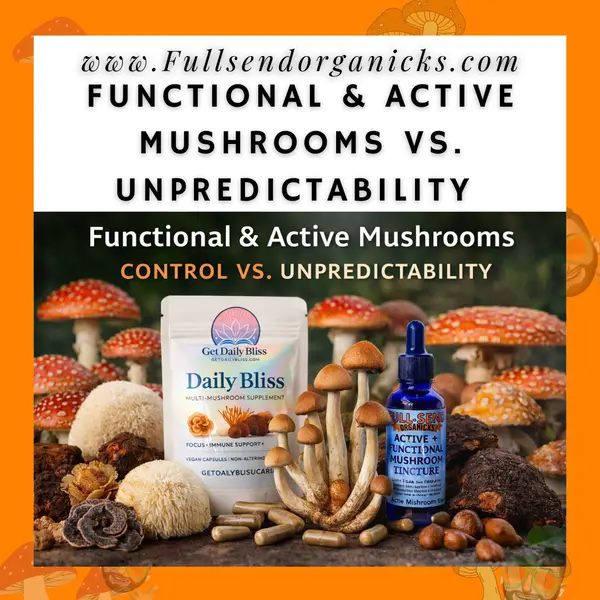
For Daily Bliss products, I use fruiting bodies intentionally, with no fillers and no fluff, because they align best with how supplements, chocolates, and tinctures are meant to be experienced. You can learn more about those formulations here:
Why This Topic Keeps Trending in 2026
As wellness consumers become more informed, they ask better questions. At the same time, platforms reward simplified narratives.
That combination leads to loud, polarized debates. However, real education lives in the middle. Understanding mushrooms means understanding systems, not slogans.
If you want a short visual explanation that touches on this idea, you can also check out this quick breakdown here:
The Takeaway: Clarity Over Conflict
Fruiting bodies and mycelium are parts of the same organism. They serve different purposes, behave differently in formulations, and belong in different conversations depending on the product.
The real issue is not which part is “better.” The real issue is clarity, transparency, and intention.
When products are built thoughtfully and explained honestly, confusion disappears.
That is the standard I build around—and the standard I believe functional mushroom wellness deserves in 2026.